

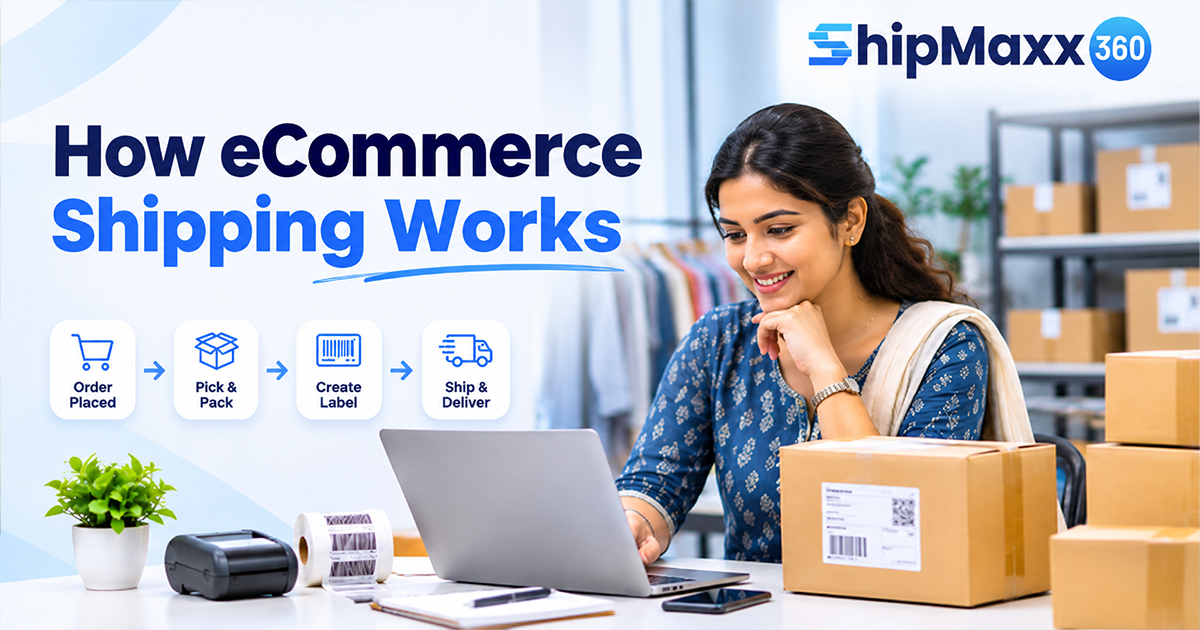
If you’re an online seller or a brand, you must be aware of the fact that every product that your customers buy from your store has a journey from store to door. It basically follows these steps: the customer places an order, the seller packs the parcel, and a courier collects and delivers it. Sounds easy, right? But the process that goes behind the scenes is more complicated than you think!
An online business has to set one benchmark to achieve growth, and that is getting the order to their customers at the right time and in the right place. And that brings in shipping, or simply delivering orders from the store/warehouse to the end customer’s doorstep.
Whilst this may sound simple to you, there are many steps involved in moving one single parcel from one point to another. This goes beyond simply packing, picking, and shipping a purchased product from store to door of the customer. So what does it take for an order to be shipped to the end customer?
Let’s learn how it all works in this blog, so that you can make better decisions while choosing the best eCommerce courier service for your online business.
What Is eCommerce Shipping?
eCommerce shipping is how your online order is shipped from the seller to the customer’s doorstep. This includes verifying order details, packing your product, selecting a courier service, tracking your package, and handling any delivery issues. Returns are also included.
How Does eCommerce Shipping Work?
1. The customer places an order
The first step is your customer purchasing the product. You’ll receive order details, including what product they’ve purchased, quantity, delivery address, payment method, and phone number.
Before shipping, you should verify that you have the product in stock and the delivery address is correct.
2. Picking & Packing
You’ll then locate the product and prepare it for delivery. This is known as picking & packing.
Packing your item correctly will ensure it arrives without damage. If your product is fragile, you may need to add extra padding. Ensure that your parcel is the correct product and quantity.
3. Choosing a Courier
Choose a courier who can deliver to the customer’s PIN code. This will often depend on the shipping cost, how quickly you want it delivered, the weight of your parcel, and the area they deliver to.
Some sellers will have one courier they use. Some will have multiple couriers to ensure you get the best option for your order.
4. Create a shipping label
Attach your shipping label to your parcel. This will usually include the delivery address, return address, and tracking number. The tracking number (also known as AWB – Air Waybill) will allow you to track your parcel.
5. Collect by courier
Once your parcel has been booked for delivery, the courier will collect it from your location/warehouse.
The parcel will then be taken to sorting centres and transport hubs. It will be delivered using road and/or air depending on where it needs to go. Once it reaches a local delivery centre, it will be ready to be sent.
6. Deliver
Your local delivery agent will deliver your parcel to your customer’s address. They may send you delivery updates.
If your order was paid for in advance, you won’t have to pay for anything. However, if it’s a cash on delivery (COD) order, the courier will collect payment and send it to you according to your payment schedule.
7. Delivery confirmed
Once your customer receives their parcel, the order will be marked as delivered. You can now mark the order as complete in your system.
If the parcel isn’t delivered, the courier may try to deliver it again. This could be because of an incorrect address, the customer wasn’t available, or they refused to accept the delivery.
What Happens If My Order isn’t Delivered?
Not every parcel you ship will be delivered on its first attempt.
You’ll get an update called a Non-Delivery Report (NDR). This will tell you why the parcel couldn’t be delivered. You may need to verify the address, contact the buyer, or ask them to try again. If the parcel still can’t be delivered, it may be returned to you. This is known as Return to Origin (RTO).
Sometimes your customer may want to return the product. Depending on your store’s return policy, you or your shipping partner will arrange a return collection.
What Affects the Cost of eCommerce Shipping?
The cost of shipping your order can vary. Some things to consider are;
- Weight & Size – Heavy or large parcels may cost more.
- Distance – Delivery to far-away locations may cost more.
- Delivery Speed – Fast delivery may cost more.
- Payment Method – Cash on delivery may incur an additional charge.
- Returns – Failed deliveries and returns may incur a charge.
Before setting a shipping cost for your customers, you should consider these factors.
How Can I Make Shipping Easier?
As your sales increase, you may find that manually processing each order becomes tedious. You may have to visit multiple courier sites, create labels, and manually track your parcels.
Using a shipping management platform will make things easier. You can import your orders, compare couriers, book shipments, print labels, and track your delivery updates in one place.
ShipMaxx by ShipMaxx360 is a tech-enabled D2C logistics solution for online brands. It allows you to manage your orders and shipments within one dashboard, choose from multiple courier partners, track your parcel, and manage any delivery issues. This can make managing your daily shipping easier as your order volume increases.
Final Thoughts
eCommerce shipping includes more than just posting a box somewhere. It includes all aspects from confirming your order to delivering it to your customer. Including returns if required.
Having a clear shipping process will help you reduce errors, have better visibility on your orders, and provide a better experience for your customers. Choosing the right tools and couriers will help make shipping easier as your business grows.