
Every customer wants an online purchase to feel like a magical experience, where the moment they tap on the Buy Now button on their smartphones, they want the order to reach their doorstep immediately or the next day. Because instant gratification is something that everybody has been addicted to for a while.
For the seller, though, that single tap kicks off a chain of events. Someone will have to confirm the order; a person will need to pack it, arrange pickup, and ensure it is delivered to the correct address. And even before all of that happens, a seller has to be prepared for everything that will go wrong in this process.
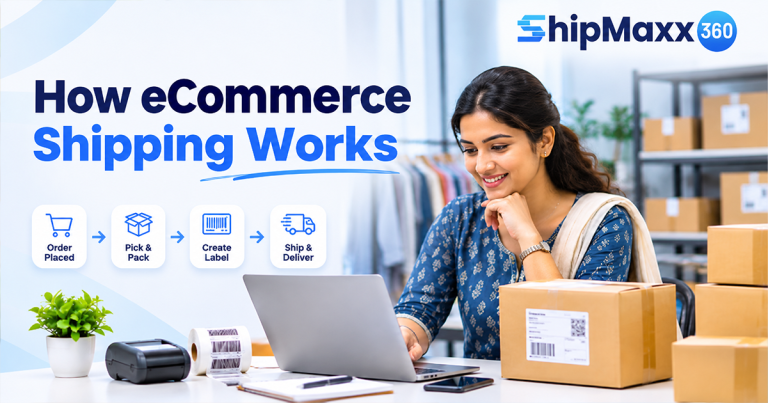
So how does the entire process of eCommerce shipping work? How many steps does it have, and what’s the journey of an order from a store to the customer’s doorstep? Let’s take a look at the entire process step by step.
What Is the eCommerce Shipping Process?
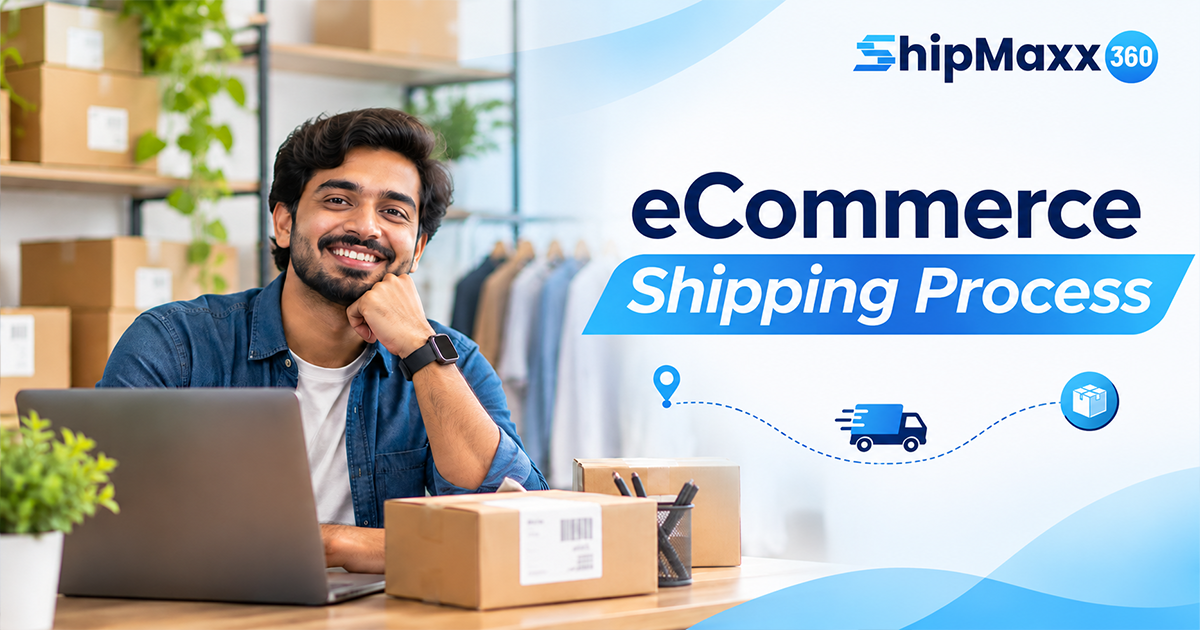
It’s the overall process of an order making its way from your store to a customer’s door. This includes packing, courier booking, shipment tracking, delivery, and sometimes returns.
This is how it works in ordinary business.
Step 1: First, Receive & Review the Order
Your customer has made an order through your eCommerce website or a marketplace. You receive shipping information, Address, Phone number, and payment method.
Make sure the item is in stock. Check that your PIN code and address are correct too. Even a tiny mistake can hold things up for you.
Step 2: Select, Pack & Weigh the Product
Next, you choose the object from your shelf, and you pack it in a safe manner. Use the box or the bag that is suitable. Use padding materials if the item has a possibility of breaking.
Count and measure the packed parcel, because that information is required for the calculation of carriage charges. If the box is much bigger than the article, it may be more costly to ship.
Step 3: Select the Right Courier
Not all courier services deliver in all PIN codes. Even for those two courier services that deliver, their eCommerce delivery prices and times can be different.
Before you decide on a courier service, find out whether the service operates in your city or town, its price, the prices for delivery to other places, the deadline, and the quality of handling parcels. The optimal choice for a home city may not be the same one for a town afar.
The success of an online store is determined by a dependable eCommerce courier service.
Step 4: Schedule Your Shipment and Generate a Label
After you find a courier, you schedule the parcel for pickup. An eCommerce courier booking service or shipping tool enables you to do this without having to type in the information multiple times.
Next, you print a label with the delivery address, return address, and a tracking number. This number is also sometimes referred to as an AWB, or Air Waybill. Affix this label somewhere it will be easy to scan.
Step 5: Pickup and Transport
The courier will take your parcel from your shop, office, or warehouse. It will pass through a network of sorting centres before arriving in the delivery area.
The item could be transported by the courier delivery service by land, by air, or both. The route will be determined by length, object type, and the assistance opted for.
Step 6: Track the Parcel
When the parcel is shipped, you can monitor the parcel’s progress via the eCommerce order tracking page. Possible statuses include: “Picked Up”, “In Transit”, “Out for Delivery”.
A tracking link saves your customers from having to inquire about the status of their orders. Effective eCommerce order tracking also allows your team to identify delays before it’s too late.
Step 7: Deliver the Order and Settle Payments
The courier delivers the parcel to the customer. Payment has already been made by the customer for the order using a prepaid order.
In the case of COD shipping, the parcel is delivered to the customer and paid for at the time of delivery. The COD courier service then applies the received amount to the seller in accordance with the payment schedule.
Step 8: Deal with Missed Deliveries and Returns
Occasionally, there is no one at the address, or the address details are incorrect, or the customer refuses to accept the goods.
The courier might file an NDR, which is an abbreviation for Non-Delivery Report. NDR management involves finding out the reason and following the procedure, e.g., asking the customer or requesting another trial.
In the case of failed delivery, the parcel is returned. This is called Return to Origin (RTO) in eCommerce. If a return request is made after delivery has been attempted, it is a distinct return process.
How Can Sellers Make eCommerce Shipping Easier?
If you’ve only got a handful of orders, that is still manageable. However, what do you do when you’ve got dozens, even hundreds of orders every single day? No worries, as it can be made easy once you understand how the eCommerce shipping process works.
But before you get started with it, you need to know the most crucial player in this shipping process: a shipping aggregator. They bring multiple shipping carriers together on a single platform, where you can compare courier rates, features, prices, coverage area, VAS services, etc., to make better decisions while choosing the best option for your business.
A shipping management platform will be able to combine your orders and shipping updates onto one dashboard. Certain platforms utilize a shipping API or courier API to pass order information back and forth between your shop and shipping system. This type of shipping API integration will help eliminate duplicated data entry.
These tools work well for D2C logistics where brands are shipping products directly to their customers.
Where Does ShipMaxx Fit In?
ShipMaxx by ShipMaxx360 is a technology-enabled eCommerce shipping solution for online and D2C brands. It enables sellers to manage orders, book shipments with multiple courier partners, generate labels, and track shipments from one unified platform. It also provides assistance with delivery problems and COD payments.
The concept is simple: do less to switch between tools, and do more to serve clients.
Final Thoughts
A smooth eCommerce delivery service starts well before the parcel goes out. Each step matters, from checking an address to handling a failed delivery.
Start with accurate order details, suitable packaging, a good courier choice, and clear tracking. As your store grows, a connected shipping system can help you keep everything organised.